Post by
  August 25, 2026 |

This guide covers one thing: what your organization needs to know about itself before AI can work reliably inside it. That is not a philosophical question. It is an operational one. AI systems, whether they route decisions, draft outputs, or coordinate tasks through a multi-agent system, depend on structured, current, and governed knowledge to produce results you can trust. Without that foundation, the system hallucinates, contradicts itself, or produces answers that were accurate six months ago and are wrong now.
By the end of this guide, you will know what organizational context for AI is, what four tests it must pass, how it is structured into three layers, how to audit and capture it, how to govern who can read or write it, and how to sustain it after AI is connected. You will also understand where AI fits inside a continuous operational loop, not as an endpoint but as one stage in a cycle your organization has to maintain.
Each section links to a dedicated supporting guide that goes deeper on that topic. Read this guide to orient, then follow the links into the areas where your gaps are largest.
Table of Contents
- What organizational context is and why it comes before AI
- The three layers of context: facts, tacit process, governance
- Auditing what your organization already knows
- Capturing tacit knowledge
- Structuring context into a single source of truth
- Governance and access control
- Readiness and connecting AI to your context
- Sustaining context: freshness, ownership, and measurement
What Organizational Context Is and Why It Comes Before AI
Organizational context is the structured, machine-readable body of knowledge. That describes how your organization works: its facts, its processes, its rules. It also describes its decisions about who is authorized to know what. It is distinct from data. Data is raw. Context is data that has been organized, validated, and connected to the operational decisions it is meant to support.
For context to be useful to an AI system, it has to pass four tests. It must be findable, meaning the system can locate the right piece of knowledge without ambiguity. Also, it must be current, meaning the knowledge reflects reality as it exists now. Not as it existed when someone last had time to update a document. It must be authoritative, meaning there is one canonical answer for any question. Not three conflicting versions across as many folders. And it must be governed, meaning there are clear rules about who can read it, who can change it, and what happens when it is wrong.
The concept of the readable organization follows from these four tests. A readable organization is one whose knowledge is structured well enough that a system, human or automated, can read it and act on it correctly. AI does not change what it means to be readable; it raises the cost of not being readable. Human teams compensate for gaps through conversation and judgment. AI systems do not. They treat what they find as complete. The supporting guide, What Organizational Context Is and Why It Comes Before AI, covers the conceptual foundation and the four tests in detail.
The Three Layers of Context: Facts, Tacit Process, and Governance
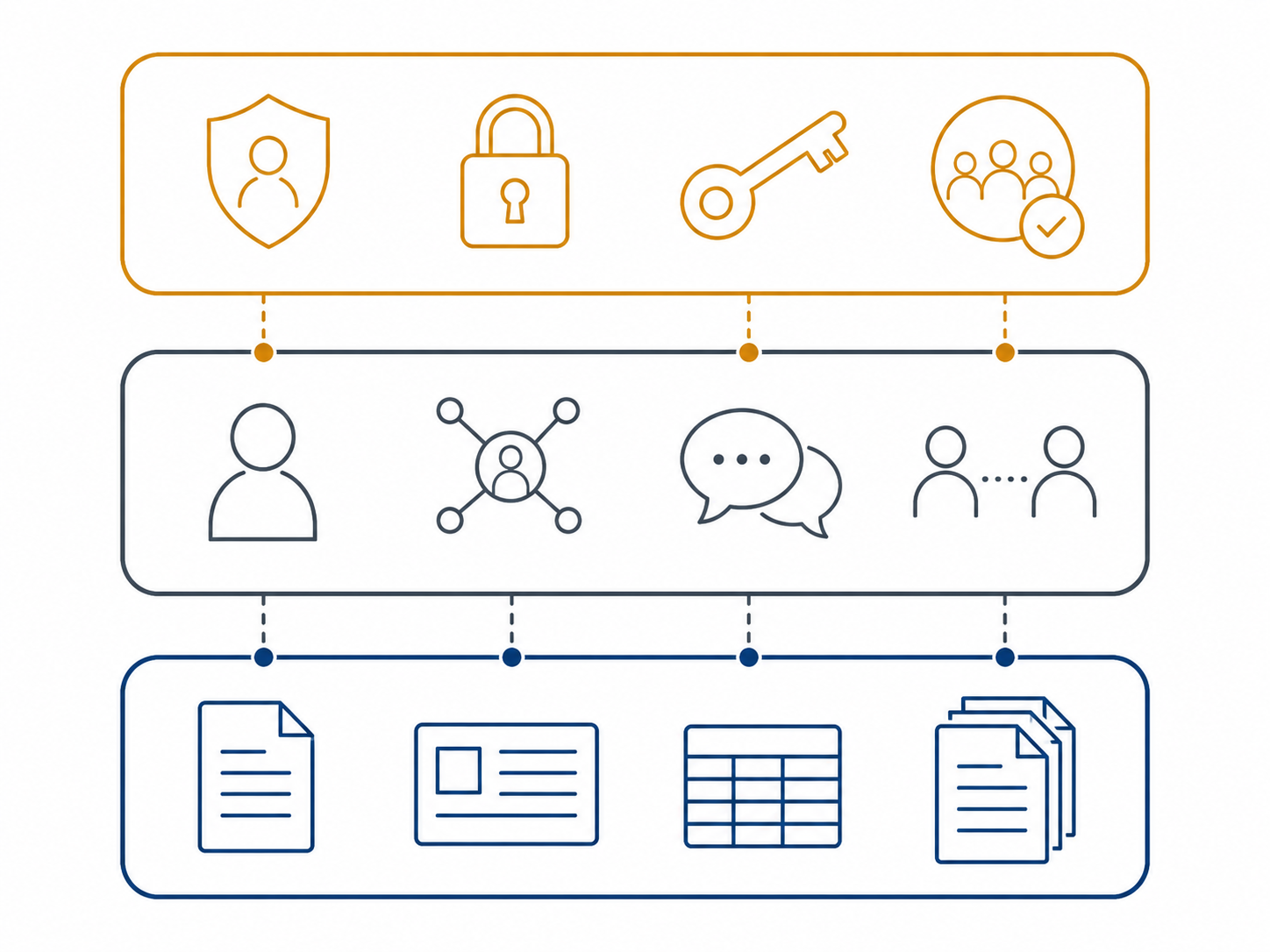
Organizational context for AI is not flat. It exists in three distinct layers, each with different characteristics and different failure modes. Treating them as a single undifferentiated mass is one of the most common mistakes organizations make when they try to prepare for AI.
The first layer is facts: structured records of what the organization is and does. Org charts, product specifications, customer tiers, regulatory obligations, system architecture diagrams. These are the easiest to capture and the easiest to verify, but they go stale faster than people expect. A product spec that is six months old may contain pricing, integration endpoints, or feature descriptions that are no longer true.
The second layer is tacit process: the knowledge that lives in people’s heads and in the patterns of how work actually gets done, as opposed to how it is supposed to get done on paper. This is the hardest layer to capture. When a senior engineer knows which three customers require manual review before any deployment, that is tacit process. It does not appear in any runbook. The third layer is governance: the rules that control who can access, change, and approve each piece of context. Governance is not an add-on. It is a layer of the knowledge itself, because knowledge without ownership rules becomes unreliable quickly. The Three Layers of Context: Facts, Tacit Process, and Governance goes deeper into how to think about and sequence work across all three.
Auditing What Your Organization Already Knows
Before you can build anything, you need an honest picture of what already exists. An organizational knowledge audit is not a documentation inventory. It is a structured assessment of where knowledge lives, whether it passes the four tests, and where the gaps are most consequential.
In practice, audits reveal three categories of knowledge: documented and current, documented and stale, and undocumented entirely. The first category is smaller than organizations expect. The second is usually the largest. A company that has been operating for three or more years typically has process documentation that reflects decisions made during an earlier product phase, by people who have since left, for a customer base that has changed. That documentation is not neutral. It actively misleads anyone who relies on it, including AI systems.
The failure mode to avoid here is the audit that produces a long list and no prioritization. Not all knowledge gaps carry the same risk. An AI system making routing or triage decisions based on stale escalation rules, for example, creates compounding errors that are hard to trace after the fact. Start with the knowledge that feeds the decisions you are planning to automate or assist. The dedicated supporting guide, Auditing What Your Organization Already Knows, provides a structured approach for scoping, running, and scoring an audit without stalling the teams you need to involve.
Capturing Tacit Knowledge
Tacit knowledge capture is where most context-building programs slow down or stop. The reason is usually process design, not people. Organizations ask subject-matter experts to write documentation in addition to their normal work, with no template, no review cycle, and no clear end state. The output is inconsistent, incomplete, and orphaned from the moment it is written.
The approaches that work consistently share a few properties. They extract knowledge through conversation rather than composition: structured interviews, incident retrospectives, and decision-log reviews produce far more useful content than asking someone to write from a blank page. They use templates that constrain format without constraining content, so the output is immediately structured for storage and retrieval. And they separate extraction from review, so the person with the knowledge is not also responsible for deciding whether it is complete.
The failure mode is capturing knowledge that is accurate when written but has no owner and no review schedule. Tacit knowledge reflects current practice. Current practice changes. A process captured in an interview last year and never touched since is now a facts problem, not a tacit knowledge problem: it is documented and stale. Capturing Tacit Knowledge Without Stalling the Business covers the specific techniques and scheduling approaches that keep capture from becoming a one-time project.
Structuring Context into a Single Source of Truth
Having knowledge captured is not the same as having it structured. Structure determines whether an AI system, or a person, can find the right answer reliably. The goal is a single source of truth: one location, one format convention, one retrieval path for each category of organizational knowledge.
This does not mean every document lives in one file. It means that for any given question there is exactly one place the answer lives, and that every other reference points to that place rather than duplicating it. Duplication is the structural failure that undermines retrieval. When a process is described in a wiki page, a team handbook, an onboarding document, and a Slack-pinned message, and each version differs slightly, no system can determine which version is authoritative. AI systems will synthesize across conflicting sources and produce a confident answer that is a blend of none of them.
The architecture of a single source of truth involves decisions about storage format, linking conventions, naming standards, and the relationship between human-readable documents and machine-readable data. It also involves a disciplined deprecation process: old versions must be removed or clearly marked, not left in place where retrieval systems can find them. Structuring Context into a Single Source of Truth covers the design decisions in detail, including how to handle the transition from the state most organizations are actually in.
Governance and Access Control
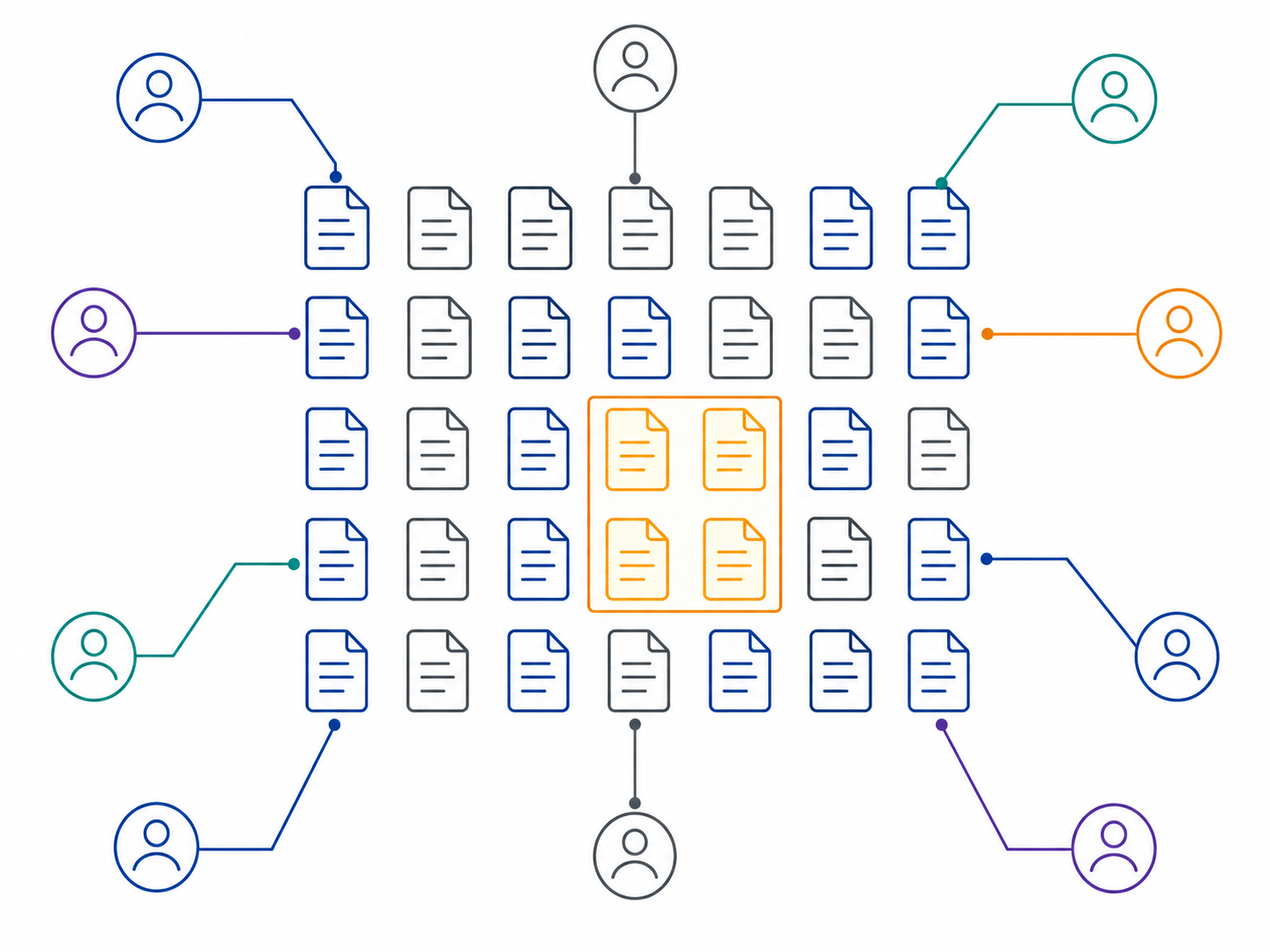
Governance is the layer that makes context reliable over time. Without it, a single source of truth degrades into an unsupervised wiki: content accumulates, ownership diffuses, and the four tests fail one by one. With it, there is a clear answer to four operational questions for every piece of knowledge: who owns it, who can read it, who can change it, and when was it last reviewed.
Access control is one part of governance and a particularly consequential one for AI. AI systems that can read organizational context for AI can also surface information to users who should not have it. A system that can read customer contract terms, employee performance notes, and infrastructure credentials from the same knowledge base and respond to queries across all of them is a serious risk, regardless of how the AI itself is configured. Role-based access control applied at the knowledge layer, not just the application layer, is the correct mitigation. This maps directly to how role-based access control operates in governed systems generally.
The failure mode here is treating governance as a compliance formality rather than an operational control. Organizations that implement governance as a policy document but not as an enforced technical constraint end up with a knowledge base where access rules exist on paper and are systematically bypassed in practice. Governance and Access: Who Is Allowed to Know What covers the governance model, access control patterns, and the audit trail requirements that make governance enforceable rather than aspirational.
Readiness and Connecting AI to Your Context
Readiness is not a binary state. It is a judgment call about whether your context foundation is solid enough in the specific area where you plan to use AI, and whether your governance controls are strong enough to catch and correct failures when they happen.
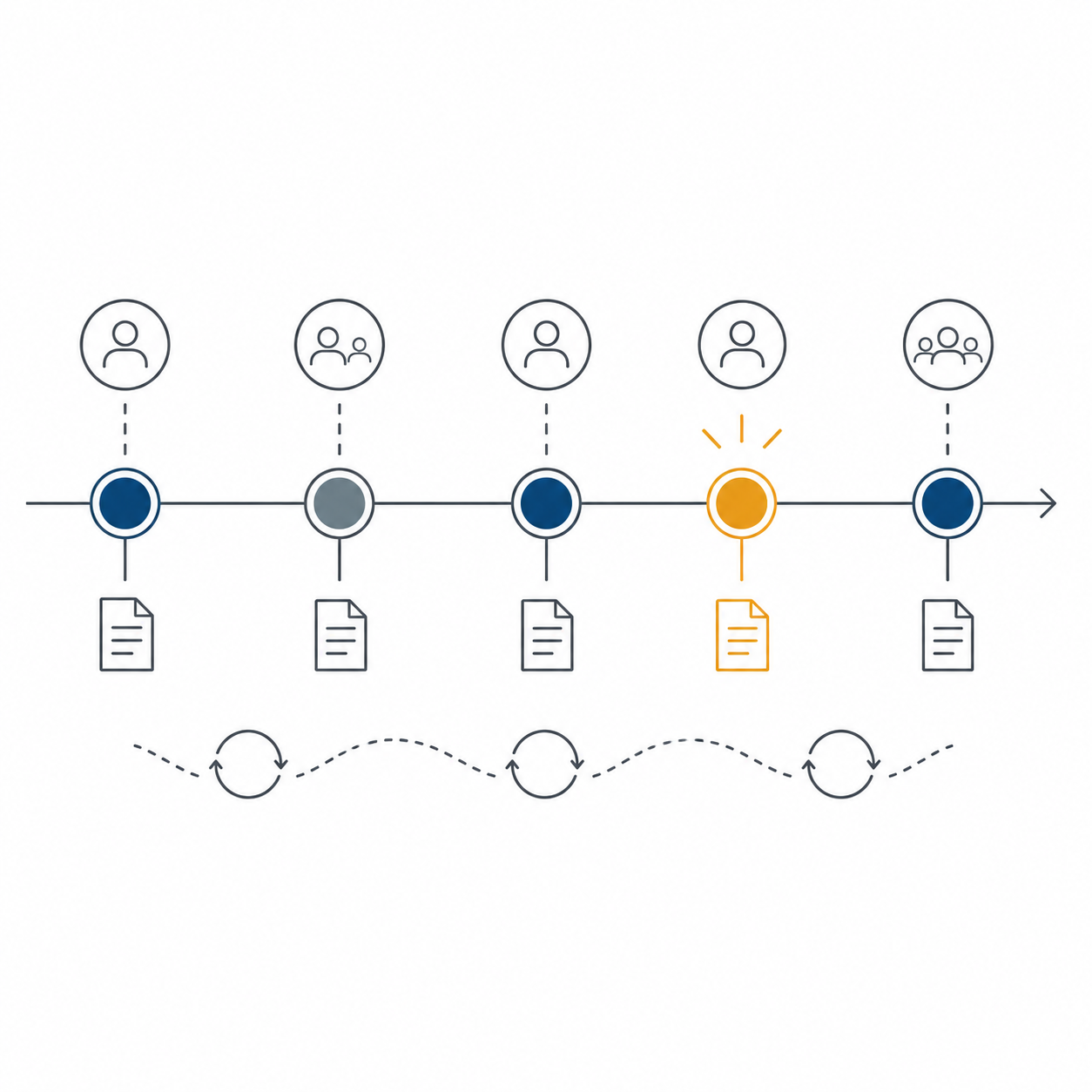
The build-govern-plug-refresh loop describes how AI fits into the broader context lifecycle. Build the context foundation. Govern it with access control and ownership rules. Plug AI in as a consumer of that foundation. Refresh the foundation continuously as the organization changes. AI is the plug step. It is not the destination. Organizations that skip the build and govern steps and go straight to plug are connecting a capable system to an unreliable input, and the output will reflect that. An autonomous AI pipeline built on stale or uncontrolled context will automate errors at scale, not just produce them occasionally.
Technical readiness assessment covers four dimensions: context completeness in the target domain, access control enforcement at the knowledge layer, a feedback mechanism for capturing AI errors and routing them back to the knowledge base, and a human review process for high-stakes decisions the AI will influence. Readiness and Connecting AI to Your Context maps each dimension to specific checks you can run before committing to a deployment.
Sustaining Context: Freshness, Ownership, and Measurement
Context that is not actively maintained degrades. The rate of degradation depends on how fast the organization changes: product releases, pricing updates, team restructuring, regulatory changes, infrastructure migrations. Any of these can make previously accurate context incorrect. For a human reader, an outdated document is an inconvenience. For an AI system, it is a fact.
Freshness requires three things: assigned ownership for every piece of knowledge, a review schedule calibrated to how quickly that category of knowledge changes, and a trigger mechanism that flags knowledge for review when a related organizational change occurs. Ownership without a schedule produces knowledge that is theoretically someone’s responsibility but practically reviewed only when something breaks. A schedule without triggers misses the in-cycle changes that happen between scheduled reviews.
Measurement closes the loop. The metrics that matter most for context health are coverage (what fraction of the knowledge the AI needs exists in the knowledge base), staleness rate (what fraction has not been reviewed within its scheduled interval), and error rate (how often AI outputs are flagged as incorrect by human reviewers). These three numbers together tell you whether the foundation is holding or degrading. Sustaining Context: Freshness, Ownership, and Measurement covers the governance structures, tooling-agnostic measurement approaches, and escalation patterns that keep context operational at scale.
How BlueGrid.io Approaches This
BlueGrid.io’s background is running engineering and security operations for technical organizations. That background shapes how it approaches organizational context for AI work: practically, with attention to what breaks in production, and without overstating what documentation alone can fix. The teams BlueGrid.io has worked with have experienced the specific failure modes described in this guide, and the approaches here reflect what has actually reduced those failures, not what sounds correct in principle.
When BlueGrid.io advises on AI adoption, the first question is always about the knowledge foundation, not the AI system. What does the organization know about itself, and is that knowledge findable, current, authoritative, and governed? If the answer to any of those is no, the conversation shifts to closing that gap before connecting anything. The connection between knowledge governance, access control, and the integrity of AI outputs is not theoretical; it is the difference between an AI deployment that compounds over time and one that accumulates technical debt in the knowledge layer until it breaks.
BlueGrid.io does not claim a long track record of AI deployments. It claims a clear view of what the foundation requires, and the operational experience to help technical teams build it without turning it into a multi-year documentation project. The goal is a knowledge base that is good enough to support a specific AI use case today, governed well enough to stay good, and structured so that the refresh loop is built into how the organization operates rather than bolted on afterward.
BlueGrid.io helps technical organizations build the context foundation AI depends on. If you want to talk through where to start, bluegrid.io.