Post by
  August 25, 2026 |

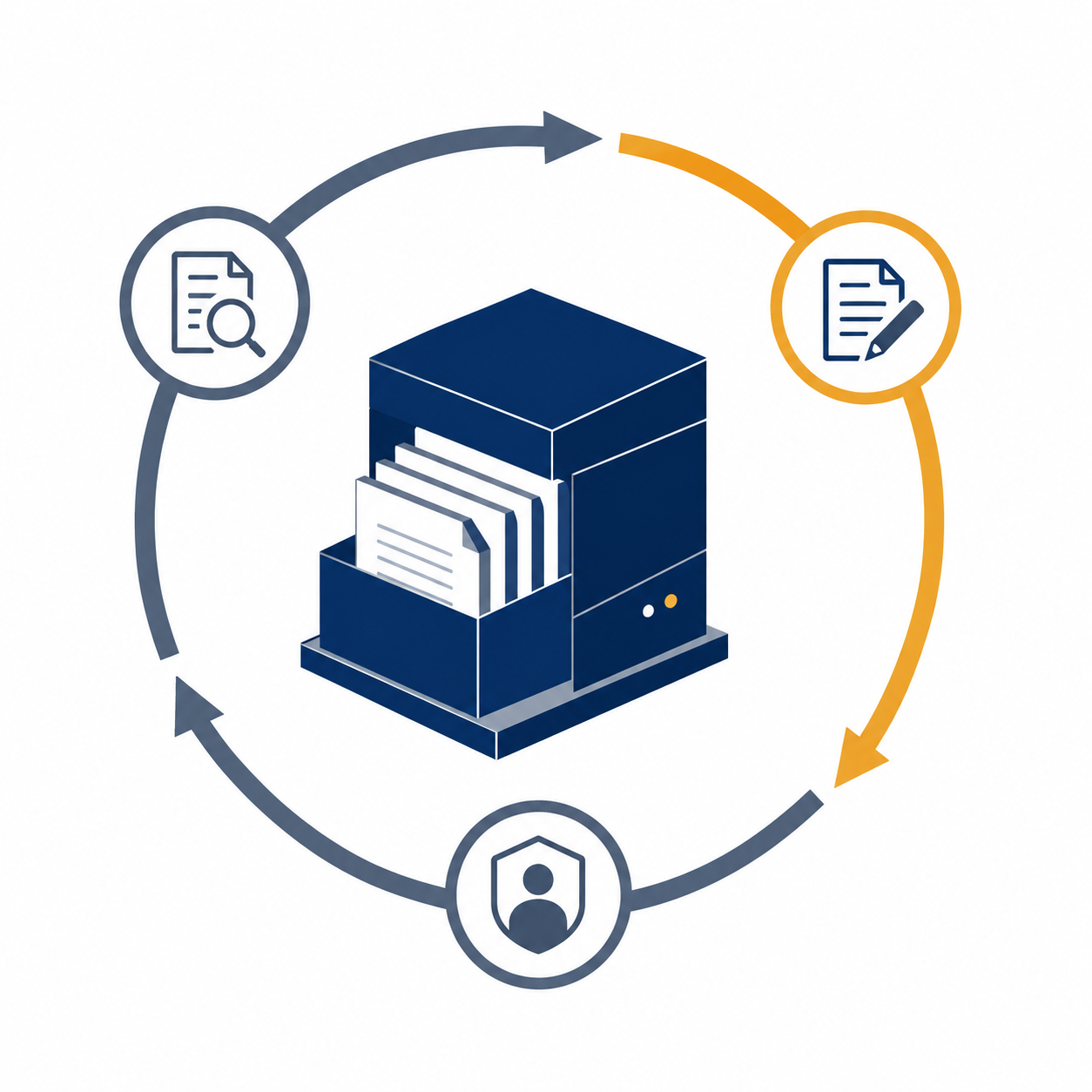
Before you connect an AI system to your organization’s knowledge, you need to be able to answer four questions honestly: Do you know what knowledge you actually run on and where it lives? Can you tell current information from outdated? Do you know what is sensitive and who should be able to see it? And do you treat that knowledge as something you maintain, not something you finished? If you cannot answer all four with confidence, pointing AI at your context will not accelerate your operations. It will amplify your existing confusion.
This guide covers both sides of the readiness problem: how to know when your context is genuinely ready, and how to make the connection between that context and an AI system in a way that produces reliable, traceable results. It also covers what goes wrong when teams skip the readiness check, because those failure modes are specific and predictable.
What readiness actually means
Readiness is not a checklist you complete once. It is a state your knowledge infrastructure either is in or is not in at the moment you try to use it. A team that documented its runbooks three years ago and has not touched them since is not ready, even if the documents still exist and are technically accessible.
You know what knowledge you run on
Start with an honest inventory. Where does the knowledge that drives daily decisions actually live? For most engineering and operations teams, knowledge lives everywhere: in wikis, tickets, internal chat history, and in the heads of the three engineers who have been there since the beginning. AI cannot read chat history reliably and it cannot interview your senior engineer. It needs knowledge that has been made explicit and stored somewhere a retrieval system can reach.
The inventory exercise is not glamorous, but it reveals something important: how much operational knowledge your team has actually captured and how much it simply assumes people know. If most critical knowledge still lives in people’s heads rather than in documents, you have a knowledge capture problem that existed before your AI plans- and you need to solve it first.
You can tell current from outdated
Stale documents are worse than no documents when you are feeding context to an AI system. A retrieval system has no way to know that the incident response procedure it just retrieved was written for an architecture you decommissioned eight months ago. It will return that document, and the AI will use it, and the answer will be confident and wrong.
Readiness on this dimension means every document that enters your AI-accessible corpus has a clear owner, a last-reviewed date, and a mechanism for flagging it as outdated when the underlying reality changes. This is not a technical problem. It is a process and ownership problem. The technical implementation is simple once you have decided who is responsible for keeping each category of knowledge current.
You know what is sensitive and who can see it
Knowledge that is appropriate for one audience is not always appropriate for another. Customer data, security configurations, personnel information, and strategic plans all carry different access requirements. When you build a context layer for AI, you are effectively building a retrieval surface, and that surface needs to respect the same access boundaries your existing systems enforce.
Role-based access control applied at the retrieval layer is the standard approach: a user querying an AI assistant should only receive answers grounded in documents they are already permitted to read. If your knowledge base does not have clear sensitivity classifications and ownership assignments, you cannot implement that control correctly. The result is either over-restriction that makes the system useless, or under-restriction that leaks information across boundaries it should not cross.
You treat context as maintained, not finished
This is where most teams underestimate the ongoing cost. Getting your context into a usable state for AI is not a project you close. It is an operational commitment. Processes change. Teams replace systems. They update policies. Every change they fail to capture in the AI-accessible knowledge base widens the gap between what the AI knows and what is actually true.
Teams that treat context as a one-time migration project typically see the quality of AI outputs degrade noticeably within three to six months. The documents were accurate at launch. Nobody updated them when things changed. The AI has no way to know the difference.
How to make the connection
Once your context meets the readiness criteria above, the question is how to connect it to an AI system in a way that produces results you can trust and defend. The principles here are straightforward, but teams frequently skip them in the rush to ship something.
Retrieval over generation
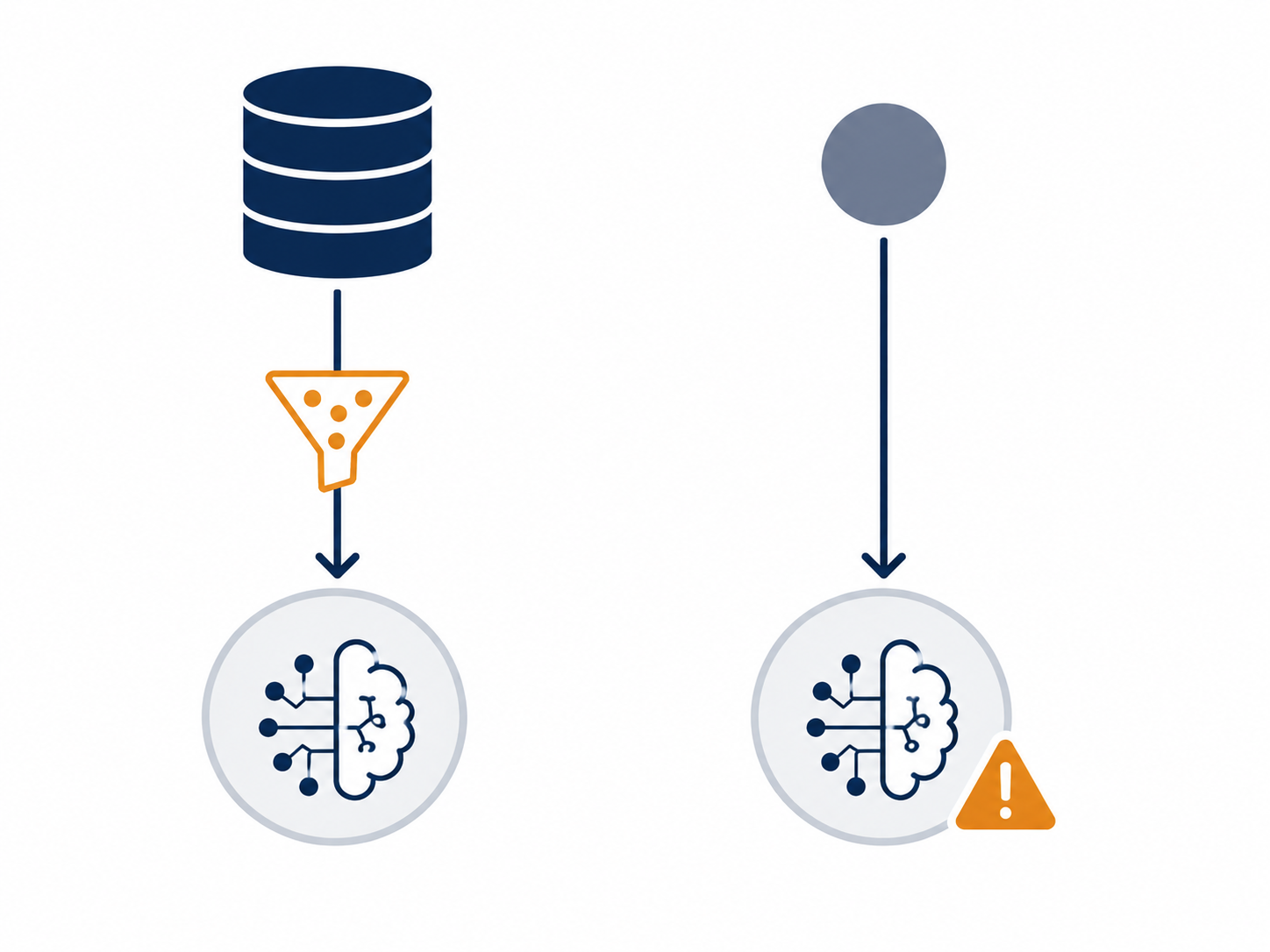
The distinction matters: retrieval-augmented approaches pull relevant documents from your knowledge base and give the AI a grounded source to reason from, rather than relying on the model to generate answers from its training alone. For organizational knowledge, this is not optional. Your internal processes, your architecture decisions, your compliance requirements, none of that is in a model’s training data. If you do not retrieve it explicitly, the model will either admit ignorance or, more dangerously, confabulate something plausible.
Retrieval architectures have their own failure modes: poor chunking that breaks context across document boundaries, retrieval that returns adjacent but not quite relevant passages, and ranking functions that favor recency or keyword density over actual relevance. These are solvable engineering problems, but they require deliberate attention. The quality of retrieval is the ceiling on the quality of AI answers.
Start narrow with one high-value use case
Pick the use case where the context is cleanest, the stakes are manageable, and the value of a correct answer is clear. Internal incident response queries are a reasonable starting point for operations teams. The knowledge domain is bounded, the users are technical and critical, and errors surface quickly. Starting with a narrow scope lets you learn where the retrieval gaps are, where the documents are stale, and where the access controls are misaligned, before those problems affect higher-stakes decisions.
Expansion should be earned. Each new domain you add to the AI-accessible corpus requires the same readiness assessment as the first. A team that succeeds with incident response queries and then immediately connects the entire company wiki without reviewing it for staleness and sensitivity has not expanded carefully. They have just deferred the problems into a larger surface area.
Ground every answer in sources with citations
Every answer the AI produces should be traceable to a specific document or set of documents in your knowledge base. This is not just about auditability, though that matters. It is about trust. When a user can see which document an answer came from, they can evaluate whether that document is current and whether it actually says what the AI claims. That feedback loop is how you catch retrieval failures and stale content before they cause real problems.
Systems that produce answers without citations make trust-building nearly impossible. Users either accept outputs uncritically, which is dangerous, or they distrust everything the system produces, which makes it useless. Citations are not a nice-to-have feature. They are the mechanism by which an organization earns confidence in its AI system over time.
What goes wrong
The failure modes here are specific enough to be worth naming directly. Understanding them as patterns is more useful than general caution.
Connecting AI before context is ready
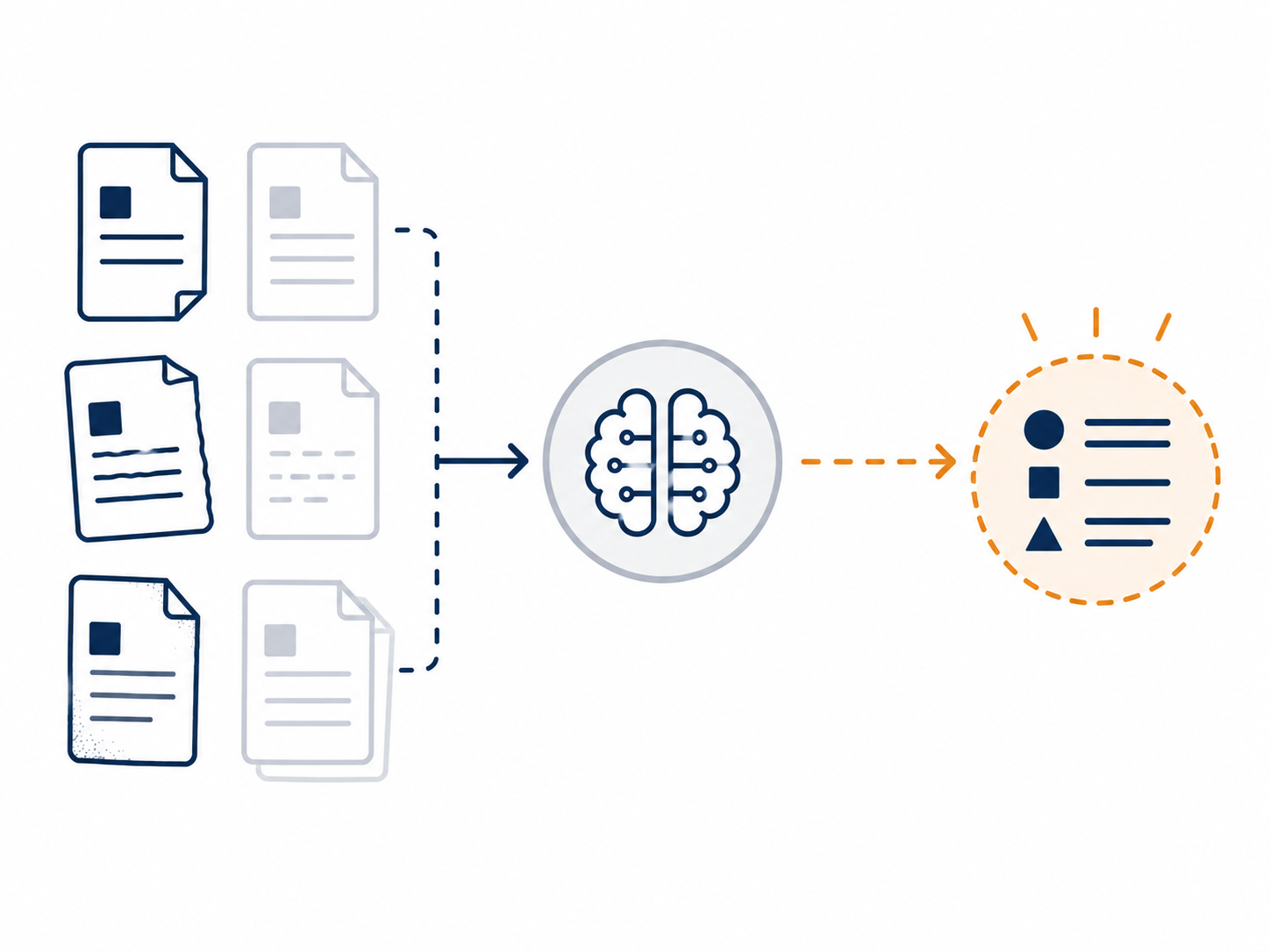
A team connects their AI assistant to a wiki that has not been meaningfully reviewed in two years. The wiki has articles that contradict each other, processes that reference systems no longer in production, and no clear ownership structure. In the first week, engineers start using the assistant for onboarding questions. It answers confidently, citing articles that are technically still present in the wiki. New engineers follow procedures that no longer apply. Some of the errors are caught quickly. Others are not caught until they cause an incident.
This failure is not caused by bad AI. It is caused by treating context readiness as someone else’s problem. The AI did exactly what it was designed to do: retrieve documents and synthesize answers. The documents were wrong. That responsibility belongs to the team that owns the knowledge base.
Ungrounded generation producing confident wrong answers
A team deploys an AI assistant in a context where retrieval is poorly configured or the relevant documents are not in the corpus. A user asks a question the system cannot answer from retrieved context. Rather than returning a clear statement that no relevant information was found, the system generates a plausible-sounding answer from the model’s general knowledge. The answer is stated with the same confidence as retrieved answers. The user has no way to tell the difference.
This is the confabulation problem, and it is particularly dangerous in operational contexts where the user is looking for a definitive answer about your specific systems or policies. You can address this by combining technical configuration, prompts that tell the model to refuse an answer when it cannot retrieve relevant context, and the citation requirement described above. A system that cannot cite a source for a claim should say so explicitly, not generate a substitute.
Access controls applied at the wrong layer
A team builds access controls into the AI assistant interface but not into the retrieval layer. Users may have restricted access to certain documents at the interface level, but the retrieval system can still pull content from them if it does not enforce the same access boundaries. As a result, the AI may use information the user should not see to shape its answer, even without exposing the original document directly.
Retrieval-augmented systems must enforce access control at the retrieval layer, filtering documents based on each user’s permissions before passing any content to the model. Interface-level controls alone are not sufficient.
Readiness as an ongoing operational posture
The framing that does the most damage is treating AI readiness as a project gate: get through the assessment, connect the system, move on. The teams that sustain useful AI-assisted operations treat context quality as a continuous operational concern, the same way they treat monitoring, incident response, or security posture.
That means regular reviews of document currency, clear processes for deprecating outdated content, ownership accountability for different knowledge domains, and a feedback loop from AI outputs back to the knowledge base when gaps or errors are discovered. This is operational discipline applied to knowledge infrastructure. It is not a new concept. It just needs to be connected explicitly to the AI systems that depend on it.
If you want a deeper treatment of the full context framework, including how to structure knowledge for AI, how to handle governance, and how to sequence adoption across your organization, the hub guide “Organizational Context for AI: The Complete Guide” covers the complete picture from foundation to operation.