Post by
 A Web3 technology company approached us with an ambitious objective: they wanted to showcase the capabilities of their new transaction protocol through a real product experience rather than a static technical demo.
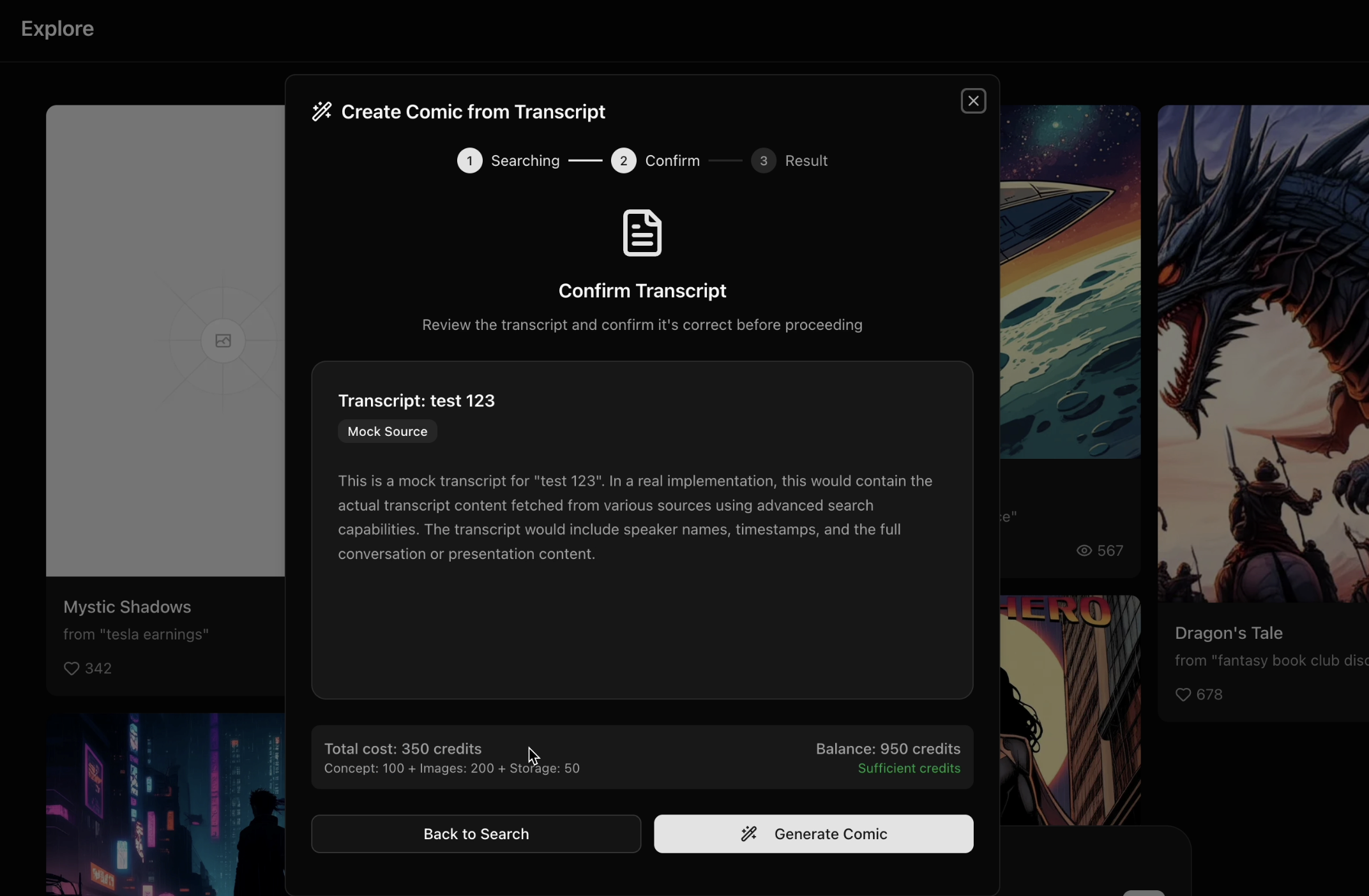
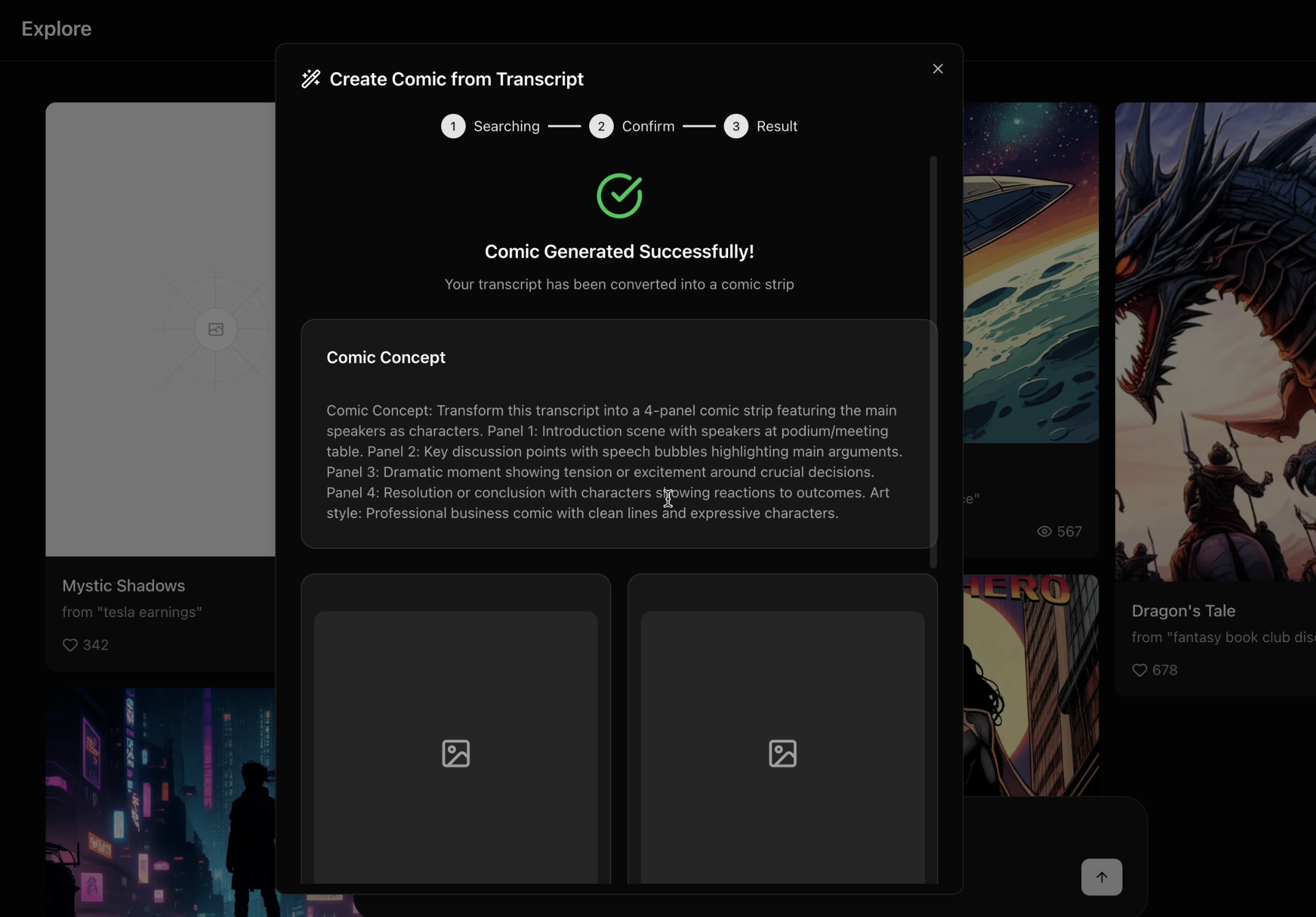
The concept was simple but powerful. Users would be able to transform transcripts – such as earnings calls or hearings – into AI-generated comic strips inside a Mini App, then publish and share them online. At the same time, the application needed to demonstrate the protocol’s broader ecosystem, including search, image generation, and wallet-based payments.
The Challenge
This project combined several layers of complexity.
The SDK was still under development, meaning endpoints and documentation changed frequently and introduced integration risk. At the same time, the application required orchestration across multiple systems, including search, LLM processing, image generation, persistence, and payments – all within a user flow that needed to feel instant.
Key risks included:
- breaking API changes during development
- latency across chained AI operations
- payment friction for users unfamiliar with crypto wallets
To address these, we focused on architecture, UX transparency, and progressive interaction design.
What We Built
We delivered a public Mini App that guides users through a multi-stage workflow while keeping the experience intuitive and fast.
Users can:
- search or paste transcripts
- generate structured comic concepts panel by panel
- produce images for each panel
- assemble and publish a comic to a public feed
Optional paid upgrades include HD export, watermark removal, and additional panels, unlocked through wallet sessions integrated directly into the Mini App.
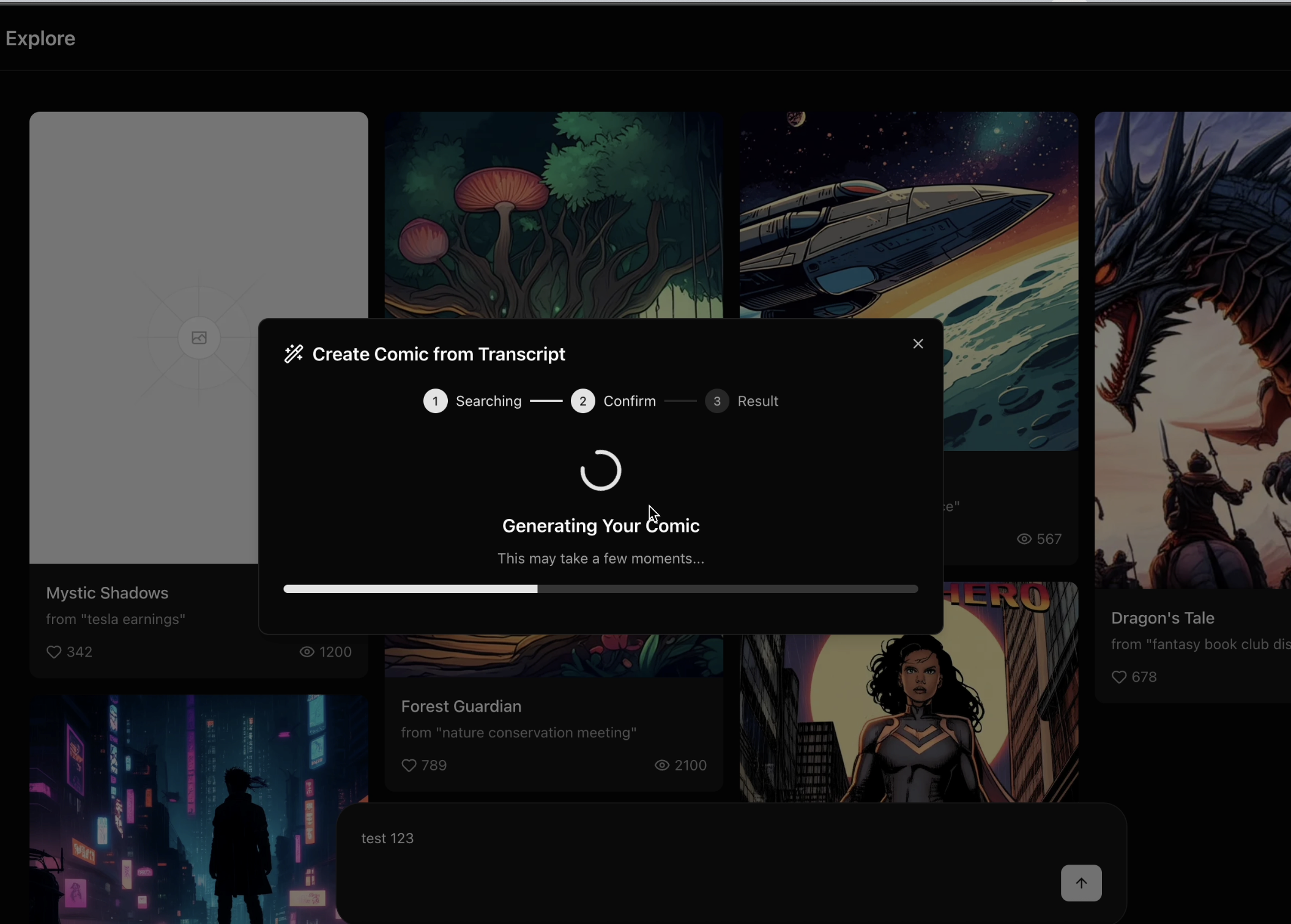
Despite the complexity behind the scenes, the full process from transcript input to shareable comic typically completes in one to two minutes.
Architecture and Approach
The solution was built using Next.js 15 and Tailwind CSS for the frontend and orchestration layer, with PostgreSQL storing comic metadata and Render supporting deployment infrastructure. The protocol SDK powered transcript search, image generation, and wallet payments, while OpenAI handled concept generation.
A critical architectural decision was introducing an orchestration adapter layer that insulated application logic from SDK volatility. Instead of directly calling SDK endpoints, the UI relied on stable internal functions that could be remapped whenever APIs changed. Feature flags further enhanced flexibility.
The AI workflow itself was structured rather than purely generative. Transcript segments were converted into deterministic JSON describing panels, captions, and scenes, allowing consistent rendering, retries, and improved observability.
Streaming played an important role in user experience. By implementing server-sent events for both concept and image generation, users could watch each panel appear in real time, significantly reducing perceived latency.
Client (Next.js App)
├─ /api/search              → ATXP.Transcripts.search(query)
├─ /api/concept [SSE]       → OpenAI: transcript → comic JSON (panels[])
├─ /api/images [SSE]        → ATXP.Images.generate(panel.prompt)
├─ /api/publish             → save comic + panels (PostgreSQL), return public slug
└─ /api/payments            → ATXP/Base wallet session (optional paid features)

PostgreSQL
├─ users
├─ comics (id, user_id, title, transcript_ref, status, cost_cents, created_at)
└─ panels (comic_id, index, caption, prompt, image_url, duration_ms)

ATXP SDK
├─ Transcripts.search
├─ Images.generate
└─ Payments/session

Render (Hosting & Deployment)
├─ Web service (Next.js)
└─ DB service (Postgres managed)
Implementation
Development followed an iterative process that prioritized speed without sacrificing stability.
The implementation included:
- early repository setup with mock data to unblock frontend work
- transcript search integration through protocol tools
- LLM prompt engineering to generate structured comic concepts
- image rendering per panel
- persistence and publication to a public feed
- wallet session integration for optional paid features
Collaboration was equally important. Daily async updates and a dedicated Slack channel enabled rapid clarification cycles and quick responses to SDK changes, keeping delivery on track despite shifting dependencies.
Deployment leveraged preview environments for pull requests and zero-downtime production releases, supported by health checks and environment-level feature flags.
Reliability, Security, and Observability
Because transcripts can contain sensitive information, privacy and reliability were built into the architecture from day one.
The solution introduced:
- server-side masking of PII patterns
- transcript truncation and avoidance of raw transcript persistence
- compact concept storage instead of original text
- correlation IDs and per-stage latency tracking
- retries with backoff for transient failures
- idempotent image rendering
- defined timeout budgets across pipeline stages
Accessibility and sharing were also addressed, with auto-generated alt text and keyboard-friendly streaming updates, along with built-in sharing to social platforms and a public comic feed.
Results
The project delivered a fully functional Mini App deployed to production that successfully demonstrated protocol orchestration in a live environment.
Performance metrics from the first weeks showed strong engagement and reliability:
- median time to first panel: ~22 seconds
- median time to publish (4 panels): ~78 seconds
- image retry rate: <3% with automatic recovery
- paid feature attach rate: 15–25% depending on cohort
Beyond performance, the application provided the client with a compelling demonstration tool combining AI generation, wallet payments, and social sharing in a single cohesive experience.
Client Feedback
Although no formal testimonial was provided, internal feedback emphasized the fast rendering of the first panel, the smooth sharing flow, and the effectiveness of the app as a demonstration of protocol capabilities. The client described the application as being “broadly in good shape.”