Post by
  December 28, 2025 |

Every production system ultimately runs on four foundational resources: CPU, memory, disk, and network. No matter how abstracted modern platforms become, these resources remain the physical reality underneath containers, virtual machines, and cloud services.
Monitoring them is not optional. Yet many teams misunderstand what these signals actually mean, how they interact, and why raw utilization numbers often mislead more than they inform. Understanding these core metrics is essential for diagnosing issues, planning capacity, and avoiding false conclusions during incidents.
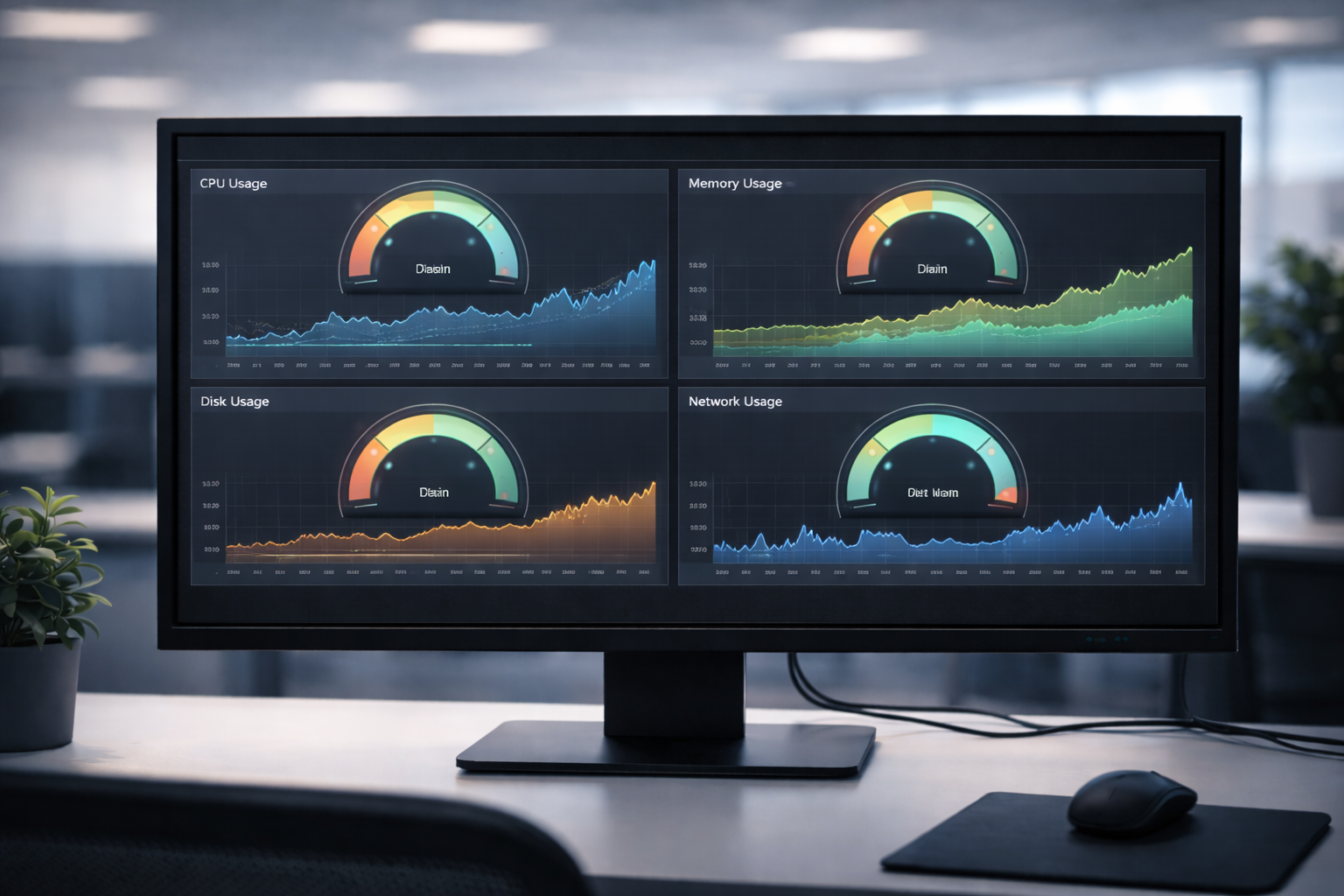
CPU Monitoring: Time, Not Percentage
CPU is often the first metric teams look at, and one of the most frequently misunderstood. High CPU usage does not automatically mean a problem. It simply means the system is busy. In many workloads, high CPU utilization is expected and healthy. The real signal lies in how CPU time is spent and whether work is being delayed.
CPU metrics become meaningful when interpreted alongside:
- Load and scheduling pressure
- Context switching behavior
- Time spent waiting rather than executing
Sustained CPU pressure can indicate insufficient capacity, inefficient code paths, or unexpected workload changes. Short spikes are often harmless. Treating every spike as an alert leads to noise and unnecessary intervention. CPU monitoring answers whether the system can keep up with demand, not whether it is working hard.
Memory Monitoring: Pressure Over Usage
Memory metrics are frequently reduced to a single number, how much is used. This oversimplification causes confusion. Modern operating systems aggressively use memory for caching. High memory usage alone rarely indicates trouble. The critical signal is memory pressure, the point at which the system struggles to satisfy allocation requests.
Warning signs include:
- Increasing swap activity
- Memory reclaim behavior
- Allocation failures or aggressive eviction
Memory pressure degrades performance gradually before causing outright failure. Latency increases, background tasks slow down, and applications behave unpredictably. Effective memory monitoring focuses on pressure and stability rather than static thresholds.
Disk Monitoring: Latency Is the Hidden Risk
Disk monitoring often starts and ends with free space. While disk exhaustion can be catastrophic, it is rarely the first symptom of trouble. Disk performance degrades long before capacity runs out. High I/O wait, increased latency, and queue buildup can severely impact applications even when plenty of space remains available.
Disk metrics matter most when they reveal:
- Read and write latency trends
- Queue depth and contention
- Error rates and retries
Storage issues are particularly dangerous because they often cascade. Slow disks cause slow databases, which cause request backlogs, which then manifest as application timeouts elsewhere. Disk monitoring protects systems from silent degradation, not just sudden failure.
Network Monitoring: Variability and Dependency
Network behavior is inherently variable. Latency fluctuates. Paths change. Congestion appears unpredictably. Because of this, network monitoring is often dismissed as unreliable or noisy. In reality, it becomes invaluable when focused on patterns rather than absolutes.
Key network signals include:
- Latency trends between critical components
- Packet loss and retransmissions
- Throughput relative to expected demand
Network issues are rarely isolated. They expose dependencies between services and environments. In distributed systems, network behavior often explains failures that appear unrelated at first glance. Network monitoring is about understanding relationships, not just measuring traffic.
Why These Metrics Must Be Interpreted Together
CPU, memory, disk, and network metrics rarely tell a complete story on their own. High CPU usage may be caused by slow disk I/O. Memory pressure may increase network retries. Network latency may amplify small inefficiencies elsewhere in the system.
Production incidents often emerge from interactions between these resources rather than from a single saturated component. Monitoring them in isolation creates blind spots. Effective monitoring correlates these signals to reveal causality, not just symptoms.
Infrastructure Metrics as Supporting Signals
These metrics describe the health of the system’s foundation. They are diagnostic by nature. They explain why a service behaves poorly, but not whether users are affected. That distinction matters. Infrastructure metrics should support higher-level service and user experience signals rather than replace them.
When infrastructure metrics are promoted to primary alerts, teams respond to resource behavior instead of impact. This misalignment is a common cause of alert fatigue.
The Cost of Misinterpreting Core Metrics
Misreading CPU, memory, disk, or network metrics leads to predictable failures. Teams scale the wrong resource. They chase utilization instead of bottlenecks. They add capacity where it is not needed and miss the real constraint entirely. A clear understanding turns these metrics from noise into insight. It allows teams to respond calmly during incidents and plan confidently for growth.
Despite the rise of observability platforms and high-level abstractions, these four metrics remain essential. They ground monitoring in physical reality. They explain behavior when higher-level signals are ambiguous. They form the bridge between system design and system operation.