Post by
  December 28, 2025 |

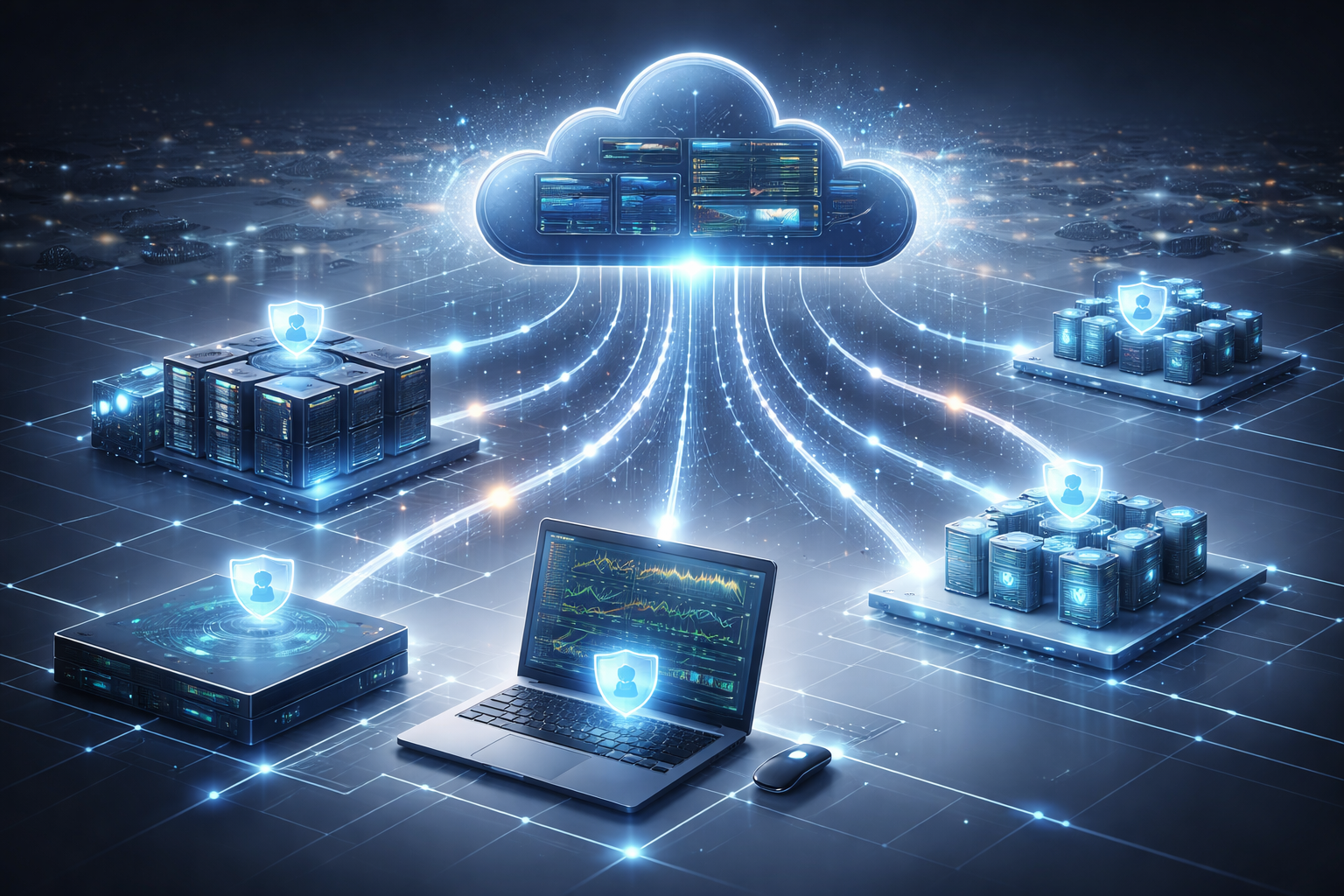
Modern monitoring systems rarely see infrastructure directly. Instead, they rely on intermediaries that live close to the systems they observe. These intermediaries are monitoring agents.
Monitoring agents are one of the least visible yet most critical components of any monitoring strategy. They collect raw signals, translate system behavior into metrics or events, and provide the foundation upon which dashboards, alerts, and automation are built.
Understanding how agents work across different platforms explains many common monitoring limitations and design choices.
What a Monitoring Agent Actually Does
At a high level, it is a small piece of software installed on or near a system being observed. Its job is to collect information about the system’s state and forward that information to a central monitoring platform. This sounds simple, but the details matter.
Agents must interact with operating system internals, respect security boundaries, operate with minimal overhead, and survive system restarts, upgrades, and failures. They must collect meaningful data without interfering with normal workloads. How this is achieved varies significantly between Linux, Windows, and network devices.
Monitoring Agents on Linux Systems
Linux has long been the most agent-friendly environment for monitoring. Most Linux monitoring agents operate as background services running with elevated but controlled privileges. They collect data by reading from kernel interfaces such as procfs and sysfs, querying system calls, and inspecting process, memory, disk, and network statistics directly from the operating system.
This approach provides deep visibility with relatively low overhead. Linux exposes a rich set of metrics by design, making it possible to monitor everything from CPU scheduling behavior to file system I/O patterns.
Because of this openness, Linux agents are often highly extensible. Plugins, custom collectors, and user-defined checks are common. This flexibility is powerful, but it also creates risk if agents are overextended or misconfigured. Linux monitoring agents excel at depth and customization, which is why they dominate in cloud and container-heavy environments.
Monitoring Agents on Windows Systems
Windows monitoring agents operate under a different set of constraints. Rather than exposing system state through virtual file systems, Windows provides structured interfaces such as performance counters, event logs, and management APIs. Monitoring agents must integrate with these systems to collect meaningful data.
This leads to a more standardized but sometimes less transparent monitoring model. Metrics are well-defined, but customization is more limited. Access control is stricter, and agents must carefully manage permissions to avoid security conflicts.
Windows monitoring often relies heavily on event-based data. Logs play a central role, especially for authentication, service behavior, and application health. While Windows agents can provide excellent visibility into system and application state, they require careful configuration to balance coverage, performance, and security.
Monitoring Network Devices Without Traditional Agents
Network devices introduce a different challenge altogether. Routers, switches, firewalls, and load balancers typically cannot run third-party software agents. Instead, monitoring relies on standardized protocols and interfaces exposed by the devices themselves.
Common approaches include polling management interfaces, subscribing to telemetry streams, or collecting flow and interface statistics. These methods provide valuable insight into traffic patterns, errors, and availability, but they lack the process-level detail available on general-purpose operating systems.
This agentless model works well for infrastructure components designed for reliability and predictability. However, it also limits flexibility. Monitoring must adapt to the capabilities exposed by the device rather than extending them. As networks become more software-defined, the line between agent-based and agentless monitoring continues to blur.
Push vs Pull Collection Models
Monitoring agents typically operate using one of two data collection models. In a pull-based model, the central monitoring system periodically requests data from the agent. This approach simplifies control and scheduling but requires inbound connectivity to the monitored system.
In a push-based model, the agent sends data outward to the monitoring backend. This model works well in restricted network environments and cloud-native setups, but shifts responsibility to the agent to manage buffering and retries. Each model has tradeoffs. Hybrid approaches are common in modern monitoring stacks, combining the predictability of pull with the flexibility of push.
Performance and Overhead Considerations
Monitoring agents are part of the system they observe. Poorly designed agents can distort the very metrics they collect. Efficient agents minimize CPU usage, memory footprint, and disk I/O. They sample at appropriate intervals and avoid excessive processing on the host. When agents become too complex, they introduce blind spots and instability rather than clarity.
This is why many modern monitoring systems emphasize lightweight agents with narrowly defined responsibilities.
Security Implications of Monitoring Agents
Because monitoring agents often run with elevated privileges, they are part of the system’s attack surface. Secure agent design includes:
- Minimal required permissions
- Encrypted communication with monitoring backends
- Strong authentication and authorization
- Regular updates and integrity checks
In regulated or sensitive environments, agent behavior must be auditable. Monitoring should increase visibility without introducing unacceptable risk.
Security considerations are especially important when agents operate across Linux, Windows, and network boundaries simultaneously.
Why Agent Design Shapes Monitoring Outcomes
Many monitoring frustrations trace back to agent behavior rather than dashboards or alerts. Missing metrics, delayed alerts, or inconsistent data often result from how agents interact with the underlying system. Choosing the right agent model for each platform is as important as choosing the monitoring backend itself.
Monitoring agents define what is possible. They shape how systems are understood and how problems are detected. Treating them as a first-class design concern leads to more reliable, scalable monitoring overall.