Short definition
A NOC (Network Operations Center) manages network availability and performance; a SOC (Security Operations Center) manages cybersecurity threats and incidents. Both are monitoring functions, but they watch for different problems and respond through different processes.
Extended definition
The confusion between NOC and SOC is common, and for good reason: both functions involve teams watching dashboards, responding to alerts, and escalating incidents. But their objectives, tooling, and skill sets are fundamentally different.
The NOC is focused on keeping infrastructure running. Its engineers track link utilization, device availability, latency, and hardware health. When a router goes down or a backbone link becomes saturated, the NOC responds. Its primary success metric is uptime: how much of the time does the infrastructure perform within agreed thresholds?
The SOC is focused on keeping the infrastructure secure. Its analysts track authentication events, threat intelligence feeds, endpoint behavior, and network traffic patterns for signs of intrusion, malware, or unauthorized access. When an account shows unusual login behavior or a workstation starts communicating with an external IP it should not know about, the SOC responds. Its primary success metric is detection and response speed: how quickly can it identify and contain a threat?
The overlap between the two functions is real. A DDoS attack, for example, is both a security event (the SOC needs to investigate origin and attribution) and a network event (the NOC needs to re-route traffic and protect infrastructure availability). In practice, organizations that run both functions develop clear handoff protocols for incidents that cross both domains.
For smaller organizations, the two functions are sometimes merged into a single team. This works better when the volume is low and the staff is experienced enough to context-switch effectively. As volume grows, the separation of alert streams and escalation paths becomes critical to response quality.
Deep technical explanation
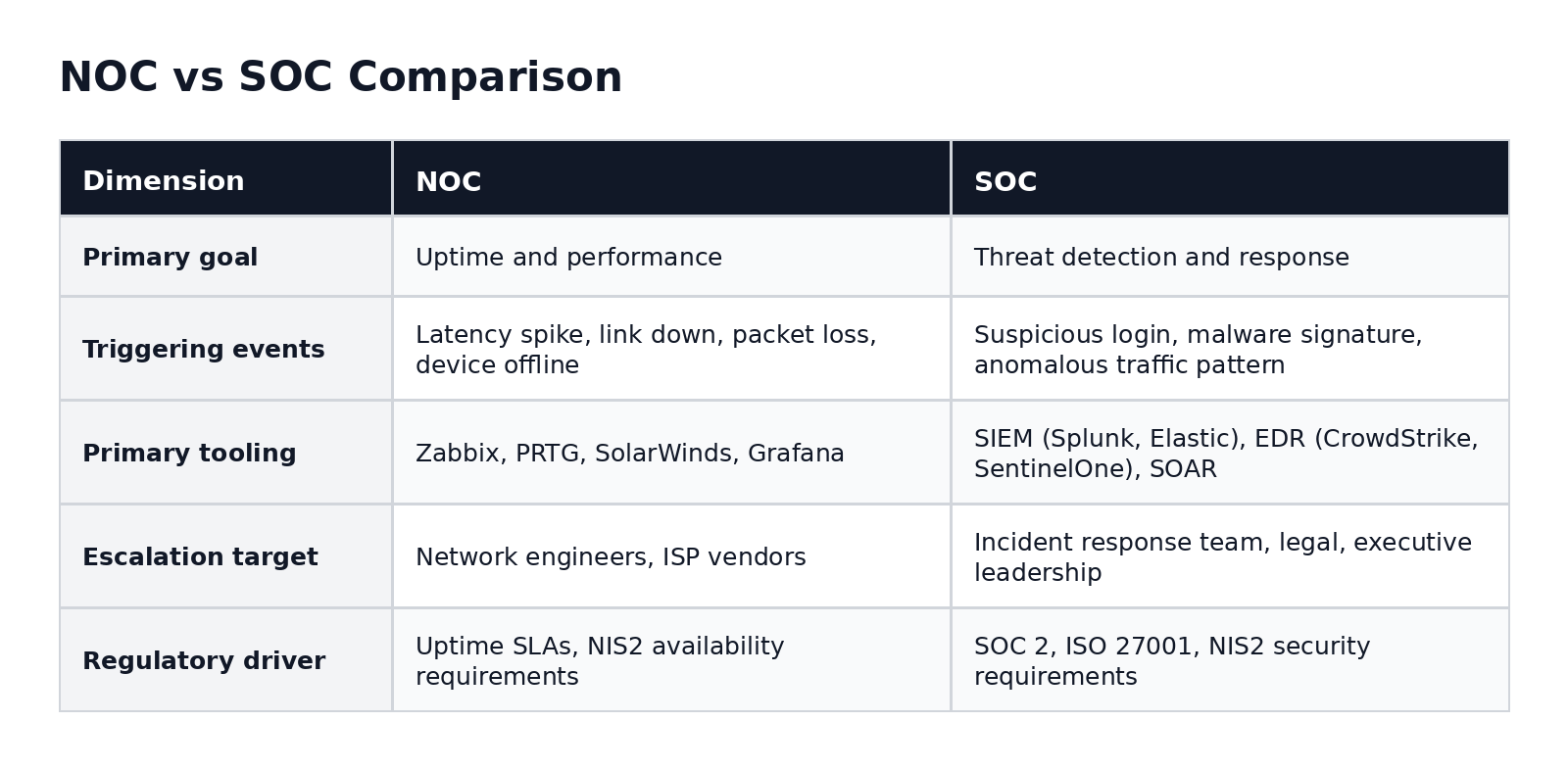
Where they overlap
Several event types require coordination between both functions:
- DDoS attacks: the NOC handles traffic re-routing and capacity response; the SOC handles threat analysis, attribution, and post-incident review.
- Insider threats: an employee downloading large volumes of data may trigger both a data exfiltration alert (SOC) and unusual bandwidth utilization (NOC).
- Misconfigured firewall rules: can appear as both a network incident (traffic not flowing as expected) and a security incident (unauthorized traffic flowing where it should not).
Integration models
Organizations handle the NOC/SOC relationship in three ways.
Separate teams with defined handoff protocols: the cleanest model for large organizations. Each team has clear ownership and a documented process for cross-domain incidents. Coordination happens through shared incident channels, not merged alert queues.
Integrated NOC/SOC: both functions operate under one management structure with shared tooling and alert streams. Engineers specialize but escalation is streamlined and joint incidents have a single incident commander.
Fully merged: a single team handles both. Common in small organizations or MSPs. Requires experienced staff and comprehensive runbook coverage to avoid gaps between the two disciplines.
Shared data sources
Both functions use some of the same raw data. Network flow data (NetFlow, sFlow) is used by the NOC for performance analysis and by the SOC for traffic pattern and lateral movement analysis. Logs from firewalls and routers feed both SIEM platforms (SOC) and monitoring dashboards (NOC). The difference is in what each team is looking for within that data and at what threshold they act.
Practical examples
A financial services company experiences a 40% spike in inbound traffic to their API servers. The NOC alerts on bandwidth saturation and begins traffic shaping. Simultaneously, the SOC identifies the traffic pattern as an application-layer DDoS with a recognizable botnet signature. The NOC and SOC work in parallel: the NOC keeps the service alive, the SOC works with the CDN provider to block the attack at the edge.
A healthcare organization running a managed SOC receives an alert about an endpoint connecting to a known command-and-control server. The SOC analyst isolates the endpoint. The NOC engineer is looped in to confirm the isolation does not break a critical clinical application that uses the same network segment.
A startup initially merges NOC and SOC responsibilities into one on-call rotation. As infrastructure scales, they find that security alerts are receiving slower response times because network performance events dominate the queue. They separate the escalation paths and assign dedicated reviewers for each alert type.
Why it matters
- Conflating NOC and SOC responsibilities leads to gaps in both: network issues get triaged with the wrong mental model, and security events are missed because the team is focused on performance metrics.
- A DDoS attack that takes down infrastructure is simultaneously a security and a network incident. Organizations without clear NOC/SOC coordination waste critical time on ownership debates while the outage continues.
- Compliance frameworks often require documented separation of, or at a minimum documented processes for, both monitoring functions. Auditors ask who monitors what and how incidents are tracked.
- As organizations scale, the volume of both network events and security events grows independently. Merging the functions indefinitely does not scale.
- Regular communication between NOC and SOC improves both disciplines. NOC data about traffic behavior informs SOC threat models; SOC intelligence about attack patterns informs NOC alert thresholds.
How BlueGrid.io uses it
- BlueGrid.io operates integrated NOC and SOC functions for clients, with separate alert pipelines and escalation paths but shared infrastructure and real-time communication.
- Our NOC handles availability and performance monitoring with a 1-hour response SLA; our SOC handles threat detection, endpoint protection, and incident response.
- For incidents that cross both domains, such as volumetric attacks or insider threats with network indicators, we follow a defined joint-response protocol with a designated lead function and a shared incident channel.
- Clients get a single operational point of contact, reducing the coordination overhead they would face managing separate NOC and SOC providers.
- We handle more than 50 combined NOC and SOC incidents per month, which means our joint-response protocols are tested against real events regularly, not just in tabletop exercises.
- Client onboarding includes an infrastructure and threat landscape review so we can calibrate the right balance of NOC and SOC coverage for each specific environment.