Post by
 Overview
This cyber threat hunting platform development case study explains how BlueGrid.io partnered with Hunt.io to design, rebuild, and scale a production-grade cyber threat hunting platform. The engagement covered the full lifecycle, from rapid prototype validation to a mature, enterprise-ready SaaS platform with a consistent release cadence.
The project demonstrates how BlueGrid.io helps security product companies move fast early, then transition safely into scalable, maintainable systems without losing momentum or customers.
Client Background
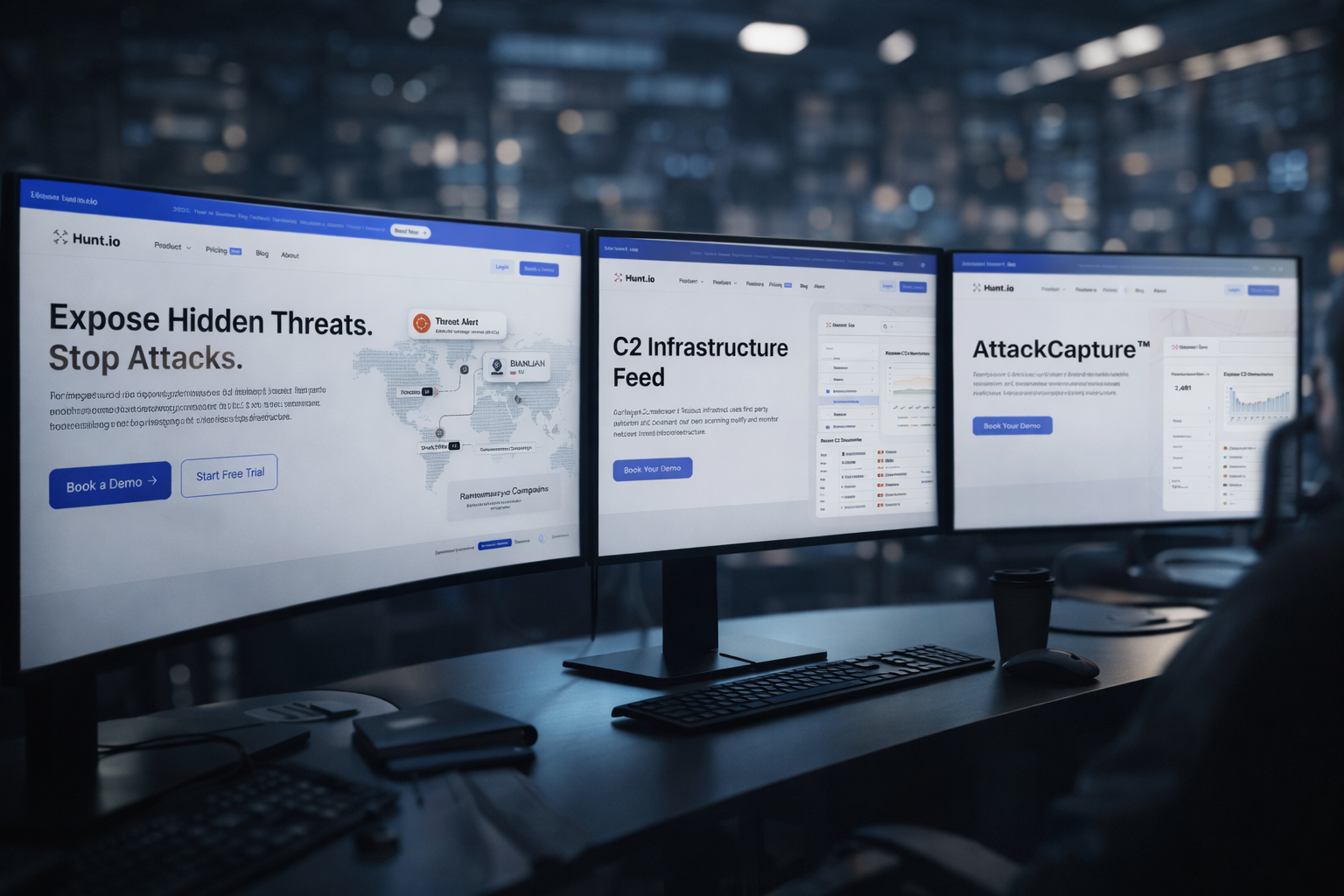
Hunt.io entered the Cyber Threat Hunting market with a clear objective. The goal was to help threat hunters stay ahead of attackers by transforming internet-scale data into high-signal, investigation-ready workflows.
Instead of exposing analysts to raw feeds, Hunt.io focused on usability, pivots, and context. Analysts needed to move efficiently from a single indicator to broader attacker infrastructure, tooling, and behavior.
From the start, the platform was designed as both a web portal and an API-driven system. This allowed direct analyst use as well as integration into SOC workflows, automation pipelines, and external CTI platforms.
BlueGrid.io partnered with Hunt.io from the earliest phase to support the cyber threat hunting platform development across product strategy, engineering, and delivery.
The Challenge
Hunt.io faced different challenges at different stages of growth.
Initially, speed was the primary concern. The idea needed to be validated quickly with real threat hunters. Over-engineering early would have slowed learning and delayed feedback.
After early validation, a new challenge emerged. The original platform was a PHP monolith built for speed, not long-term scale. As customers onboarded and expectations increased, the architecture became a limiting factor.
At the same time, the platform could not pause. Customers relied on it, and market traction mattered. A full rebuild had to happen without disrupting existing users.
Finally, once the new platform was launched, the challenge shifted to execution discipline. The cyber threat hunting platform needed frequent releases, strong API stability, and continuous UX and performance improvements.
The Solution
BlueGrid.io acted as an embedded product engineering partner, adapting the delivery approach as Hunt.io evolved while maintaining consistent standards.
Rapid Prototype for Cyber Threat Hunting Platform Validation
In October 2022, BlueGrid.io helped deliver a working portal and API within weeks. The objective was simple. Validate the cyber threat hunting platform concept with real analysts as fast as possible.
The prototype focused on two core capabilities:
- Analytics around Command and Control infrastructure associated with malware families
- Discovery and investigation of exposed open directories on the public internet, later branded as AttackCapture
This early cyber threat hunting platform prototype was sufficient to onboard early users and collect actionable feedback.
MVP Expansion and Early Customers
Throughout 2023, the platform evolved toward MVP maturity. In August 2023, the team expanded, allowing Hunt.io to onboard early customers while continuing rapid iteration.
This phase balanced delivery and learning. User feedback directly informed feature prioritization and workflow improvements. At the same time, operational constraints became clearer.
Rebuilding the Cyber Threat Hunting Platform for Production
By early 2024, it was clear the prototype architecture could not support long-term growth. BlueGrid.io and Hunt.io aligned on a full rebuild strategy rather than incremental patching.
In May 2024, development began on a new production-grade cyber threat hunting platform with clear goals:
- Separation of backend and frontend architecture
- Proper staging and production environments
- Gradual migration of core functionality
- No disruption to existing users
This rebuild preserved customer continuity while creating a foundation suitable for enterprise requirements.
Team Composition
The cyber threat hunting platform was delivered by a small, cross-functional team provided by BlueGrid.io, working closely with Hunt.io leadership and domain experts.
The core team included:
- Technical Lead responsible for platform architecture and rebuild strategy
- Backend Engineers focused on data ingestion, APIs, HuntSQL, and intelligence workflows
- Frontend Engineer responsible for analyzing UX and investigating flows
- QA and automation support, ensuring API stability and regression safety
- Delivery coordination supporting prioritization and release cadence
The team remained intentionally lean to maintain speed, ownership, and engineering quality.
Implementation and Delivery
Cyber Threat Hunting Platform Release Cadence in 2025
The rebuilt platform launched as Hunt v2.0 in March 2025. This release introduced major improvements in performance, usability, and intelligence depth while allowing a controlled transition from the prototype.
From that point forward, the cyber threat hunting platform followed a consistent monthly release cadence.
March 2025: Hunt v2.0
Key improvements included:
- Modernized interface and improved performance
- Major AttackCapture workflow enhancements
- Threat Actor intelligence aggregating indicators from over 200 public research sources with human review
- HuntSQL graduating from beta with advanced querying and large-scale exports
- Visual IP history covering ports, certificates, and associations
- Expanded API supporting AttackCapture, C2 feeds, IP enrichment, and remote SQL execution
- Integrations with Cyware and OpenCTI using STIX-based connectors
Subsequent Releases
From May through December 2025, the platform continued to evolve with releases focused on:
- Analyst productivity and automation
- Deeper investigation workflows and pivoting
- HostRadar for infrastructure attribution
- Enterprise features such as SAML 2.0 SSO
- Risk and reputation signals for IPs and domains
- Expanded intelligence coverage and filtering
Each release improved the cyber threat hunting platform without sacrificing stability or performance.
Tech Stack
- Kafka – streaming and ingestion of large volumes of internet and threat intelligence data, enabling decoupled and reliable processing pipelines
- ClickHouse – high-performance analytics and historical querying across massive datasets, supporting pivots, timelines, and bulk exports
- Elasticsearch – fast indexing and search across indicators, artifacts, and investigation metadata for responsive analyst workflows
- Go – performance-critical backend services and APIs requiring low latency and efficient resource usage
- Elixir – highly concurrent and resilient processing workflows handling continuous intelligence ingestion and enrichment
- Python – data processing, enrichment logic, analysis workflows, and intelligence correlation tasks
- React – investigation-focused frontend delivering a responsive user interface optimized for complex datasets and rapid analyst pivoting
Results and Impact
This cyber threat hunting platform development engagement delivered measurable outcomes:
- A working prototype delivered in weeks
- Early customers onboarded during active development
- A full platform rebuild without user disruption
- A consistent, high-velocity release cadence across 2025
- Continuous improvements in intelligence depth, UX, and enterprise readiness
Throughout the engagement, BlueGrid.io maintained strong engineering discipline. Code quality, API test coverage, performance optimization, and data correctness remained core priorities.
Ongoing Partnership
Hunt.io continues to expand its cyber threat hunting platform. Current work focuses on deeper intelligence coverage, stronger investigation pivots, and further improvements to platform polish and reliability.
This case study demonstrates how BlueGrid.io supports security product companies through the full lifecycle of cyber threat hunting platform development, from early validation to enterprise-scale execution.