Post by
  June 3, 2025 |

You probably won’t hear him brag, but this guy is the reason things just work smoothly. Somehow, he always knows how to help when you get stuck with tools or tech problems.
I remember when he joined BlueGrid.io – he started by fixing internal tools and automating tasks that made work easier for all of us. Since then, he’s grown into new roles, worked with different clients, and taken on new challenges, always with the same calm confidence and smart way of seeing the big picture that makes him someone we can always count on.
What’s really cool is that his path to DevOps didn’t start with computers – it began with geography.
Want to know how that all connects? Keep reading.
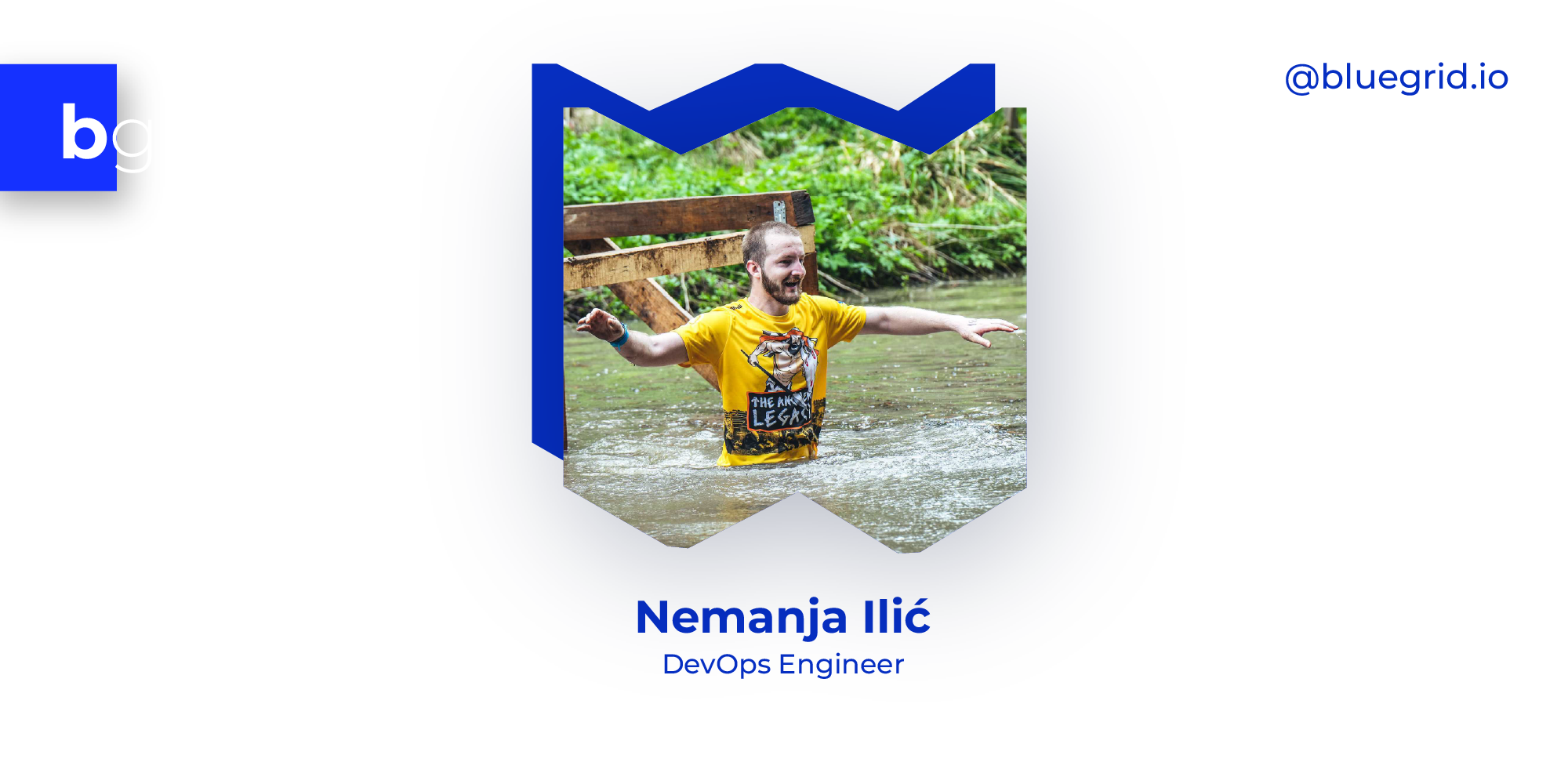
Looking back on your childhood, you were interested in geography and are now deep in tech. What drew you to this path, and is there any secret link between DevOps and geography?
Looking back, my journey from geography to tech might seem like a leap, but for me, it’s always been about understanding systems, how different pieces interact, depend on each other, and form a bigger picture.
I still remember getting my first geography atlas in preschool. I’d spend hours flipping through the pages, memorizing countries, mountain ranges, and rivers, trying to understand how everything connected. That curiosity about how the world is structured never really went away; it just evolved.
In DevOps, I found a similar sense of mapping and system-building. You’re constantly dealing with infrastructure, dependencies, and data flows, much like geography, it’s about navigating complexity. You’re drawing boundaries, building bridges, optimizing routes, just with pipelines and services instead of roads and rivers. DevOps gave me a modern map to work with.
DevOps is a unique space, it blends so many skills. What was that moment or experience in your career that made you think, “Yup, DevOps is where I want to be!”?
For me, that “this is it” moment came when I was working on a project that required setting up a CI/CD pipeline for the first time. I was still relatively new to the DevOps space, and suddenly I found myself deep in automation, Docker, Jenkins, cloud infrastructure, and debugging everything in between.
It was chaotic, but I loved it. I realized I wasn’t just writing scripts or fixing servers, I was building a bridge between development and operations. I could speed up delivery, improve reliability, and actually make life easier for entire teams. That sense of impact and ownership really resonated with me.
Also, DevOps is constantly evolving. There’s always something to learn, automate, or improve. That mix of technical depth and big-picture thinking is exactly what I enjoy most.
As a DevOps Engineer, your role is between development and operations, keeping everything flowing. Let’s describe your typical workday in this role.
Honestly, no two days are the same, and that’s what I enjoy most about this role. As a DevOps Engineer, I’m constantly switching contexts between supporting the development and operations teams.
Some days, I’m helping developers deploy new applications or troubleshoot CI/CD issues. Other times, I’m working with the operations team to resolve incidents, fix environment inconsistencies, or handle infrastructure requests.
Then there are the bigger-picture tasks, like improving workflows, streamlining deployments, implementing better automation, or introducing new tools that boost efficiency and reliability across the board.
It’s a balance between being reactive when needed and proactive when possible. Whether it’s hands-on debugging or strategic improvements, my role is really about keeping everything flowing and enabling both teams to move faster and safer.
What is that one thing you enjoy most about your role and project?
It is helping people. When a developer or someone from the operations team comes to me with a problem, and I’m able to fix it or build something that makes their job easier, it’s genuinely satisfying. I like being the one who unblocks others and helps things move forward.
At the same time, DevOps is such a rich and diverse field. It brings together so many different tools and technologies. Even the simplest task can be approached in multiple ways, and there’s always room to improve. So, I’m never bored – and I’m always learning something new, whether it’s a better way to automate a workflow, optimize performance, or secure infrastructure.
From your perspective, what is one common misconception people have about this role?
I’d say one common misconception is that DevOps is just about automation or writing scripts, like we’re here to set up the pipeline and then step aside. But the reality is much more than that…
It’s about understanding the entire software lifecycle and being involved at every stage, from planning and building to deploying, monitoring, and improving. We’re not just toolsmiths; we’re problem-solvers who connect the dots between development, operations, security, and business needs.
A lot of our work is invisible when it’s working well, like preventing outages, optimizing performance, or improving the developer experience. So while it might seem simple from the outside, there’s a lot of strategy, troubleshooting, and coordination happening behind the scenes.
You’ve been with us for more than two years now – time flies! How has your role as a DevOps Engineer grown or shifted during that time?
That’s actually one of the things I love about being in DevOps – the role naturally evolves depending on the client or organization’s needs. When I first joined BlueGrid.io, I started out working on some internal projects. My focus was on setting up CI/CD pipelines, building out infrastructure, and creating automations that made life easier for non-dev teams by removing a lot of manual, repetitive tasks.
Over time, I transitioned to working with a client who had a completely different environment and set of challenges. That shift pushed me to adapt, learn new tools, and rethink how I approached problems. It’s been exciting to step into new systems and bring fresh solutions to the table.
It’s not just about technical skills, but also about understanding people, systems, and how to improve the way they all work together. That constant evolution keeps things fresh and helps me grow both technically and professionally.
Talking about technical skills, what do you think are the most important tech and non-tech skills for this role?
On the technical side, I think the most important skills are a strong understanding of infrastructure, automation tools, and a solid grasp of scripting, whether it’s Bash, Python, or similar. You don’t need to be a full-time developer, but you do need to know how things work under the hood and how to make them work together.
But equally important are the non-technical skills. Communication is so important. DevOps sits between multiple teams, so being able to explain technical issues clearly and collaboratively is critical. Problem-solving and adaptability are also key. Things break, systems change, and sometimes you need to improvise under pressure.
Empathy is also a game-changer here. Understanding what developers or ops teams are struggling with helps you build better solutions. So DevOps isn’t just about tools, it’s about making life easier for the people using them.
What key technologies/tools do you use daily, and which ones do you like most to work with?
Juggling tools is part of the job, but it’s also one of the things that keeps it interesting. On a daily basis, I work with Kubernetes, GitHub Actions, Argo CD, Helm, Prometheus/Grafana, and of course, Linux – the foundation of everything.
As for favorites, I really enjoy working with Kubernetes. It’s complex, but once you understand how it works, it gives you a lot of power and flexibility. I also like GitHub Actions for how easy it is to plug into existing workflows and automate things quickly.
Working with a great team makes all the difference! What’s one thing you enjoy about the team here at BlueGrid.io?
It makes a big difference when you’re surrounded by teammates who are not only skilled and reliable but also fun to hang out with.
Everyone’s genuinely great to work with and easy to get along with. Whether we’re collaborating on a complex task or just chatting casually, the atmosphere is always positive and supportive.
Let’s talk hobbies for a sec! You surprised us at the NY Party with your drumming skills. If you could jam with any band in the world, who would you pick?
I’d say Arctic Monkeys since it’s my all-time favourite band. I might not be on tour-level drums yet, but I’ve got enough rhythm to turn heads before security decides it’s time for me to go. 😎

You’re also a fan of board games – so if you had to play just one board game for the rest of your life, which one would it be and why?
Tough choice, but if I had to pick just one board game to play for the rest of my life, it would be Catan. It has the perfect mix of strategy, luck, and player interaction. Every game plays out differently depending on the board setup and how people trade, so it never really gets old.
Alright, last one! Based on your experience, what’s your top advice for someone who’s exploring a career in DevOps?
My advice would be: start small, stay curious, and don’t be afraid to break things; that’s how you learn.
When I first got into DevOps, I didn’t try to learn everything at once, I focused on understanding how things connect: how code gets deployed, how infrastructure runs behind the scenes, and how to automate repetitive tasks. From there, I kept building on that knowledge, learning new tools as I needed them, not all at once.
Also, don’t underestimate the importance of soft skills. Communicating, staying calm under pressure, and being a team player are just as important as knowing Kubernetes or Terraform.
And finally, enjoy the process. DevOps isn’t just a job, it’s a mindset of continuous improvement. There’s always something new to learn, which means it never gets boring.